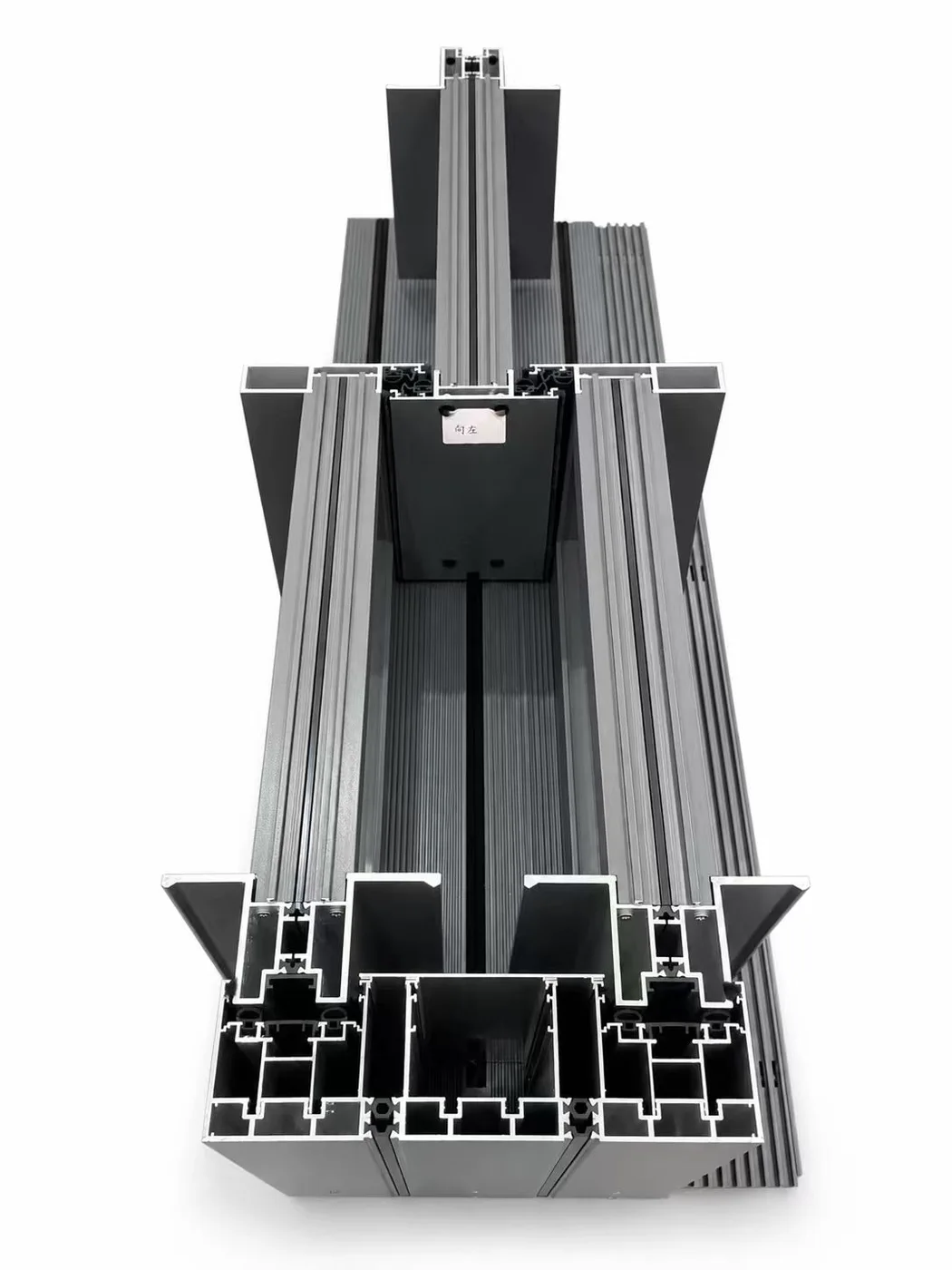
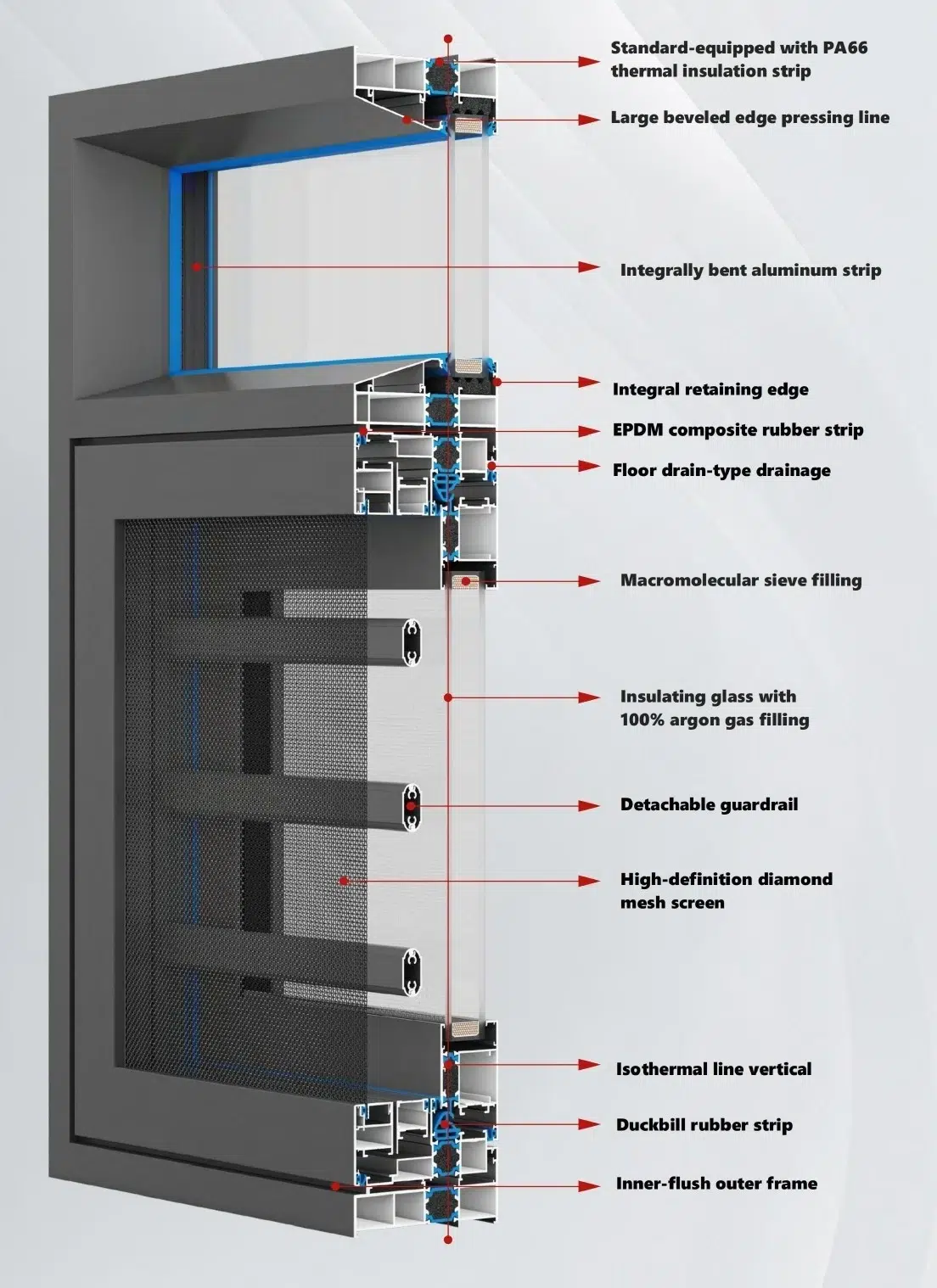
Powder coating and anodizing are the two main finishes for aluminum windows near the sea, and each one behaves differently in salt air.
Quick answer: Both finishes can perform well near the sea, but only when the entire finish system matches the exposure. Anodizing converts the aluminum surface into an integral oxide layer, so it cannot peel like an applied paint film. Powder coating provides a thicker protective barrier and far more color freedom, but its long-term adhesion depends on pretreatment, film build, curing, fabrication and maintenance. For severe coastal projects, MT Flying normally evaluates a properly sealed AA20 or AA25 anodized finish, or an architectural TIGER Drylac powder system with enhanced seaside pretreatment.
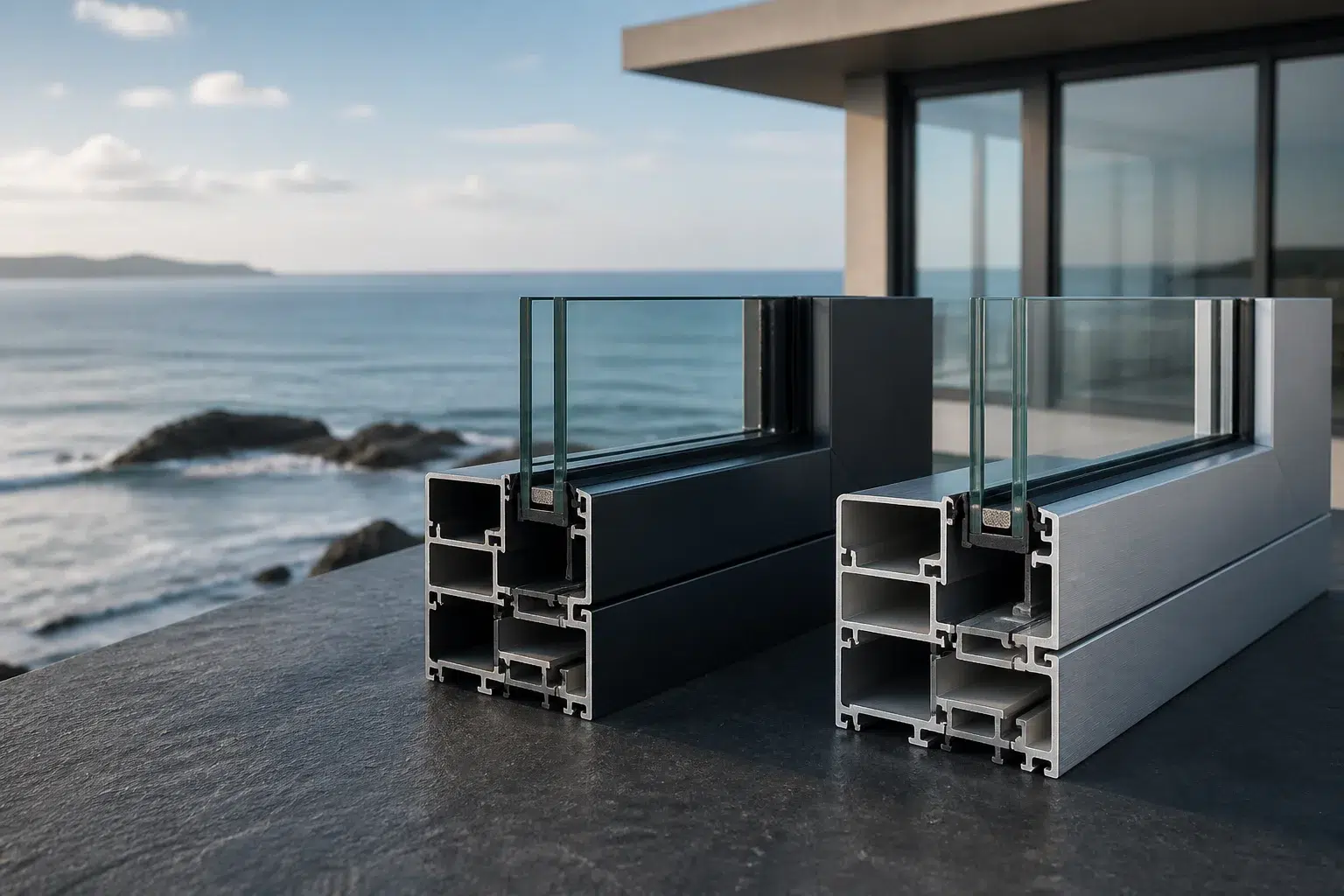
Coastal buyers often ask one simple question: “Which finish is more corrosion resistant?” The more useful question is: Which complete specification will keep this particular window, door or facade acceptable at this particular site?
Distance from the shoreline matters, but it is not enough. Wind direction, building height, sheltered balconies, rain washing, humidity, drainage, nearby pools, cleaning access and the materials touching the aluminum all change the risk. A finish that performs well on an open, rain-washed facade may deteriorate faster under a canopy where salty deposits remain wet and are never rinsed away.
This guide explains how powder coating and anodizing work, what coastal sea fog actually does to aluminum systems, what to include in an RFQ, and how MT Flying structures finish assurances for qualified projects.
1. Powder Coating and Anodizing Are Fundamentally Different
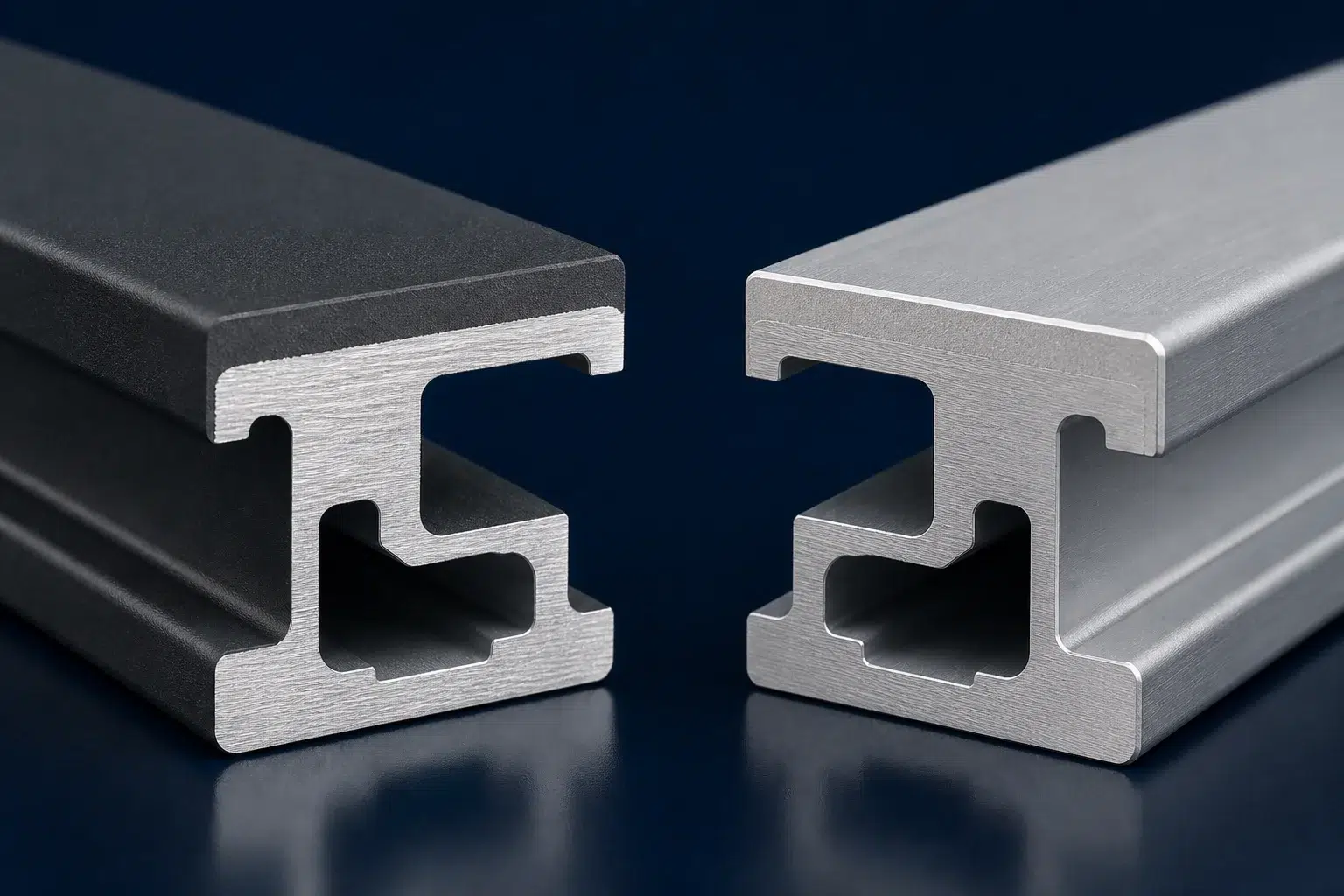
Powder coating: an applied organic barrier
Architectural powder coating is sprayed electrostatically onto pretreated aluminum and cured to form a continuous organic film. The powder chemistry controls weatherability and color retention, while the pretreatment creates the chemical and mechanical foundation needed for adhesion.
A good powder-coated finish therefore depends on five linked controls:
- Cleaning and removal of extrusion contaminants.
- Correct etching or surface preparation.
- A suitable conversion coating or approved anodic pretreatment.
- Uniform powder film thickness, including edges and recesses.
- Full curing within the powder manufacturer’s specified metal-temperature window.
Powder coating offers the widest choice of solid colors, metallic effects, gloss levels and textures. It is also easier to coordinate across windows, doors, facade panels and other painted metalwork.
TIGER Drylac offers architectural powder systems aligned with AAMA 2603, 2604 and 2605 performance levels. Its Series 75 is the hyper-durable tier formulated for AAMA 2605 requirements, while super-durable ranges are available for AAMA 2604 applications. The correct series must be selected for the project’s UV, color, location and warranty requirements.
Anodizing: an oxide layer grown from the aluminum
Anodizing is an electrochemical conversion process. It increases the thickness of the aluminum’s natural oxide layer rather than placing a separate paint film on top. After anodizing, the porous oxide is sealed to improve resistance to staining and corrosion.
This integral structure gives anodizing several important characteristics:
- It cannot delaminate or peel in the same way as an applied organic coating.
- It retains a genuine metallic appearance.
- It has strong abrasion resistance.
- Its color range is more limited, and appearance can vary with alloy, extrusion process, surface preparation and viewing angle.
- If the coating is too thin, poorly sealed or exposed to aggressive chlorides and trapped contamination, pitting, staining or localized attack can still occur.
The current QUALANOD specification defines common thickness classes including AA15, AA20 and AA25. These are minimum average thickness classes, not marketing names. For example, AA20 requires a minimum average thickness of 20 µm and a minimum local thickness of 16 µm; AA25 requires 25 µm average and 20 µm local.
2. What Coastal “Sea Fog” Means for Aluminum
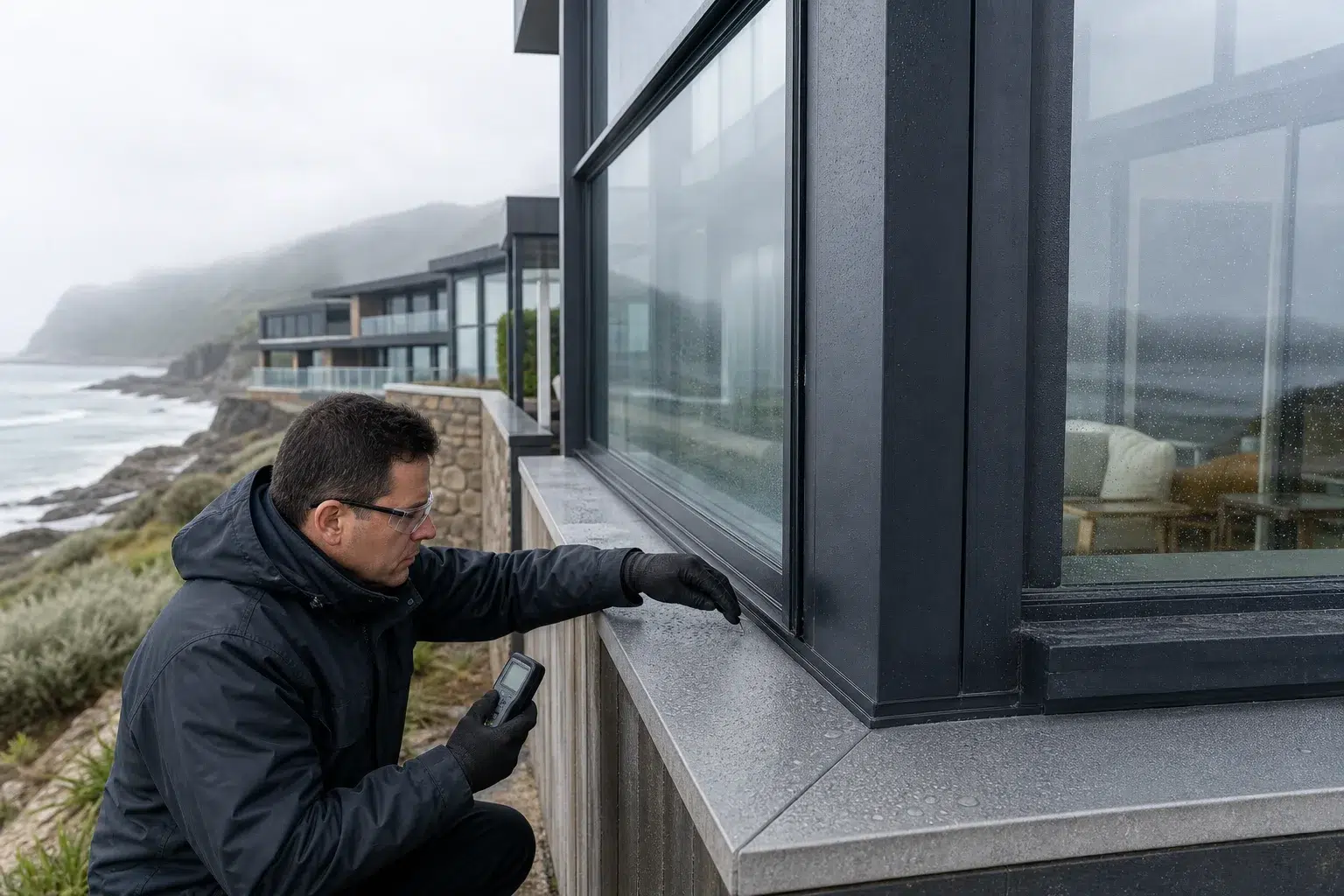
Sea fog is normally an advection fog: warm, moist air moves over colder water, cools to saturation and produces suspended droplets. Fog itself is mostly water, but a coastal atmosphere can also carry airborne salinity from sea spray and wave action. Once chlorides are deposited on a frame, repeated wetting and drying can concentrate them at joints, edges and sheltered horizontal surfaces.
ISO 9223 identifies the temperature-humidity complex, airborne salinity and sulfur dioxide pollution as principal factors in atmospheric corrosivity. For windows and doors, those environmental factors interact with very local design details.
The coastal exposure mechanisms that matter most
| Exposure mechanism | What happens on the building | Why it matters |
|---|---|---|
| Airborne chloride deposition | Salt settles on frames, tracks, gaskets and hardware | Chlorides attract moisture and can sustain localized corrosion |
| Long time of wetness | Fog, condensation and high humidity keep deposits damp | Electrochemical corrosion processes remain active longer |
| Wet-dry cycling | Deposits dissolve, dry and become more concentrated | Repeated concentration increases stress at defects and interfaces |
| Sheltered surfaces | Balconies, soffits and recesses receive little natural rain washing | Salt accumulates even when the facade looks protected |
| Cut edges and drilled holes | Fabrication or site work exposes untreated aluminum | Local defects become preferred corrosion initiation points |
| Crevices and blocked drainage | Water remains inside tracks, joints or end conditions | Oxygen and chloride gradients intensify localized attack |
| Dissimilar-metal contact | Aluminum touches unsuitable fasteners or other metals while wet | Galvanic corrosion can occur if materials are not isolated |
| Cement and chemical contamination | Wet mortar, alkaline cleaners or aggressive solvents contact frames | Finishes can stain, soften or lose adhesion |
This is why a coastal finish decision cannot be based only on the powder brand or anodizing color sample. The project also needs compatible fasteners, drainage continuity, protected cut edges, isolated metal interfaces and an achievable cleaning plan.
3. Powder Coating vs Anodizing: Practical Comparison
| Selection factor | Architectural powder coating | Architectural anodizing |
|---|---|---|
| Relationship to substrate | Applied organic film over pretreated aluminum | Integral aluminum oxide conversion layer |
| Typical appearance | Broad colors, metallics, gloss and texture choices | Natural silver, bronze and a narrower metallic palette |
| Coastal strength | Thick barrier protection when pretreatment, film and cure are controlled | No paint-film peeling; strong abrasion and metallic stability |
| Main coastal vulnerability | Adhesion loss, filiform corrosion or under-film corrosion if pretreatment, edges or damage are poor | Pitting, staining or color variation if thickness, sealing, alloy or cleaning are inadequate |
| Thickness approach | Follow the approved powder data sheet and exposure class; some TIGER C5 systems require at least 70 µm continuous film | Specify a measured thickness class such as AA20 or AA25 for demanding exterior exposure |
| Color consistency | Usually easier across large batches, but metallics still need controlled application and samples | Alloy, extrusion die, texture and anodizing batch can affect tone |
| Repair after site damage | Local touch-up is possible, although it may remain visible and will not equal factory coating | Field repair is difficult to make visually invisible |
| Edge and recess control | Requires good electrostatic application, pretreatment coverage and fabrication planning | Coating follows the aluminum surface, but post-anodizing cuts still expose metal |
| Cleaning | Mild, pH-neutral cleaning; aggressive coastal sites need more frequent washing | Mild cleaning and regular salt removal; avoid strong alkali and abrasive products |
| Best fit | Projects needing controlled colors, brand palettes or coordinated painted components | Projects prioritizing true metallic appearance, abrasion resistance and no organic-film peeling |
4. Which Finish Should Be Used Near the Sea?
Choose a high-performance TIGER powder-coating system when:
- The project needs black, white, gray, custom RAL colors, metallic effects or controlled gloss.
- Windows must match facade panels, railings or other painted components.
- A repair strategy for occasional site damage is desirable.
- The coater can document seaside-grade pretreatment, powder batch, film thickness and curing.
- The selected product has an architectural durability class appropriate to the location, building height and UV exposure.
For aggressive coastal exposure, the pretreatment is just as important as the powder. QUALICOAT’s SEASIDE approach uses enhanced pretreatment intended to reduce filiform-corrosion risk. Its minimum surface-removal requirement is higher than standard pretreatment, commonly stated as at least 2.0 g/m² for the enhanced etching route. An approved anodic pretreatment is another recognized seaside path.
Choose anodizing when:
- The design requires an authentic satin-metal appearance.
- High abrasion resistance is important.
- The buyer wants a finish that does not peel as a separate film.
- The profile alloy, extrusion quality, surface preparation and batch controls can be coordinated.
- The project can accept the tighter and more natural anodized color palette.
For demanding coastal architecture, MT Flying commonly discusses AA20 or AA25 rather than treating a thin decorative anodize as automatically suitable. The final class must be agreed against the site exposure, alloy, color, sealing method, applicable specification and maintenance conditions.
For the harshest splash or marine zones
Neither finish should be used as an excuse to ignore detailing. Direct sea-spray zones, constantly wet sills, unwashed sheltered frames and swimming-pool environments may require project-specific corrosion engineering. Review:
- 316-grade or otherwise approved fasteners and hardware where required.
- Isolation between aluminum and incompatible metals.
- Factory treatment of cuts before assembly where practical.
- Drainage holes, end dams and paths that cannot be blocked by sealant.
- Protection from wet cement, plaster dust and aggressive facade cleaners.
- Replaceable hardware and accessible maintenance zones.
5. A Coastal Finish Specification Buyers Can Actually Use
Avoid RFQ phrases such as “best powder,” “marine grade” or “thick anodizing” without measurable requirements. Include the following information.
Site information
- Project city and exact coastal location.
- Approximate distance from open sea, bay, harbor or salt-water pool.
- Building height and windward/leeward elevations.
- Exposed, sheltered and horizontal frame areas.
- Industrial pollution or nearby chemical sources.
- Expected cleaning access and frequency.
Example powder-coating schedule
Architectural powder coating using an approved TIGER Drylac system selected for the project’s coastal and UV exposure. Provide documented pretreatment suitable for the specified marine environment, continuous dry-film thickness in accordance with the approved product and project requirement, verified cure, color/gloss sample approval, adhesion testing and corrosion-test evidence relevant to the complete coating system. Protect all finished surfaces during fabrication, packing and installation.
Example anodizing schedule
Sulfuric-acid architectural anodizing to the agreed QUALANOD/ISO 7599 requirements, thickness class AA20 or AA25 as scheduled, properly sealed, with minimum average and local thickness verified on production samples. Confirm alloy, surface preparation, color limits, sealing-quality test, batch control, packaging and protection of post-fabrication edges.
These are procurement starting points, not substitutes for the facade consultant’s or local authority’s requirements.
6. Testing: What Salt-Spray Hours Can and Cannot Prove
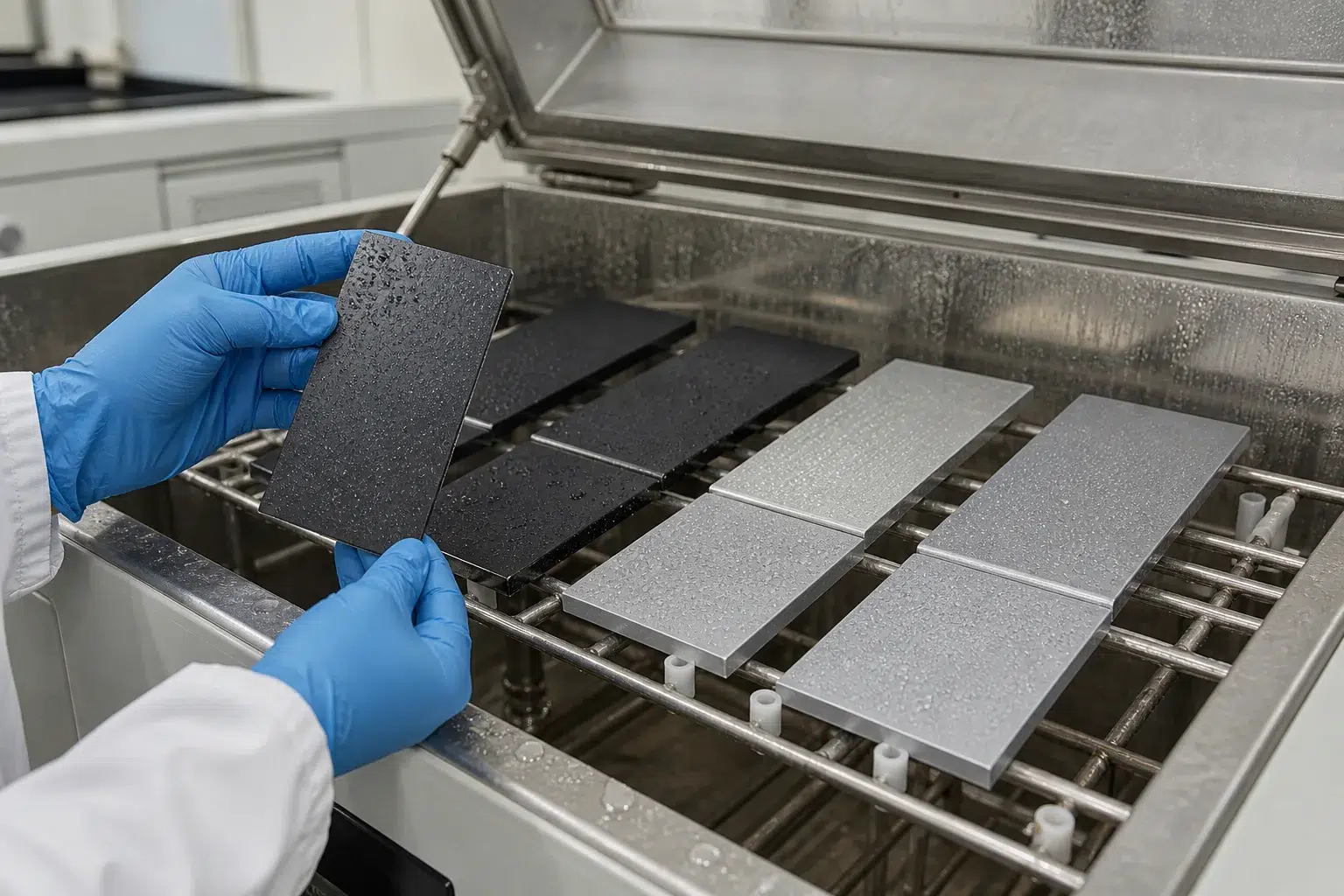
ISO 9227 and ASTM B117 describe controlled salt-spray or salt-fog test environments. They are useful for detecting pores, discontinuities, process instability and other defects in protective finishes.
However, ISO 9227 explicitly cautions that salt-spray testing is not intended to rank unrelated materials or predict long-term outdoor service life. A statement such as “1,000 salt-spray hours equals 15 years near the sea” is therefore not technically defensible.
A responsible submittal package should combine relevant testing with process records:
- Coating or anodic-film thickness readings.
- Powder adhesion and cure checks.
- Color and gloss control.
- Pretreatment concentration, time and bath-control records.
- Anodizing sealing-quality checks.
- Salt-spray, humidity or filiform-corrosion tests where the governing specification requires them.
- Approved sample panels linked to the production batch.
- Traceable inspection and nonconformance records.
7. MT Flying Finish Assurance
Anodized aluminum: 15 years or more for qualifying projects
MT Flying can provide a 15-year or longer anodized-finish warranty for qualifying exterior architectural projects. The written warranty is based on an approved combination of alloy, surface preparation, anodic thickness class, sealing, color, fabrication sequence, location, installation protection and maintenance plan.
For severe coastal exposure, the specification will normally be reviewed around an appropriate architectural class such as AA20 or AA25. A thin decorative anodize should not be represented as equivalent to a heavy-duty coastal system.
TIGER Drylac powder coating: no-peeling assurance
For approved projects using the specified TIGER Drylac architectural powder, MT Flying provides a no-peeling assurance against coating-adhesion failure when the agreed pretreatment, powder product, film build, curing, fabrication, installation protection and maintenance conditions are followed.
This assurance is deliberately tied to the complete coating system. Even premium powder cannot compensate for skipped pretreatment, contaminated aluminum, under-curing, field cuts left untreated, standing salt water, incompatible chemicals or mechanical damage. Project-specific warranty wording should identify the applicable powder series, coated components, exposure zone, duration, inspection documents, maintenance duties and exclusions.
TIGER’s own architectural warranty framework also places responsibility on approved coating partners to document pretreatment and processing conditions. That is the correct model: the powder material and the application process must be controlled together.
8. Maintenance in Coastal and Sea-Fog Environments
No architectural finish is maintenance-free near the sea. A practical handover plan should include:
- Remove construction dust, cement residue, adhesive and protective film promptly.
- Wash frames with fresh water and a mild pH-neutral detergent.
- Use soft cloths or non-abrasive brushes.
- Rinse joints, tracks, drainage outlets and sheltered horizontal surfaces.
- Do not use strong alkalis, acids, abrasive pads or unapproved solvents.
- Inspect scratches, cut edges, fasteners, sealants, gaskets and drainage paths.
- Record cleaning dates and repairs when the finish warranty requires maintenance evidence.
TIGER recommends at least annual cleaning in standard C1-C4 environments and at least every three months in aggressive C5 environments for its Series 75 guidance. Actual coastal frequency should increase when salt deposits become visible or when natural rain cannot wash the surface.
9. Final Recommendation
There is no universal winner.
- Use properly sealed AA20/AA25 anodizing when the project values a genuine metallic finish, abrasion resistance and a surface that cannot peel like paint.
- Use an appropriately selected TIGER Drylac architectural powder system with seaside-grade pretreatment when the project needs color freedom, coordinated facade finishes and a documented no-peeling coating system.
- For severe coastal exposure, specify the entire assembly, including pretreatment, coating class, measured thickness, fasteners, isolation, fabrication protection, drainage, testing and cleaning.
The best decision is the one that can be written into the quotation, verified during production and maintained after handover.
MT Flying supplies custom aluminum profiles and complete windows and doors for international projects. Send the project location, drawings, finish reference, quantity and required warranty period to michael@mtflying.com or WhatsApp +86 153 0285 6248 for a project-specific finish recommendation.
Frequently Asked Questions
Is anodized aluminum always better than powder coating near the sea?
No. Properly sealed, sufficiently thick anodizing performs very well, but a high-performance powder system with enhanced seaside pretreatment can also provide excellent coastal service. Site exposure, color requirements, fabrication, drainage and maintenance should decide.
Can anodizing peel?
Anodizing is an oxide layer grown from the aluminum, so it does not peel like an applied paint film. It can still suffer staining, pitting or localized corrosion if the layer is too thin, poorly sealed, damaged or exposed to aggressive chloride deposits.
Does TIGER powder coating guarantee that aluminum will never corrode?
No coating can make that unconditional promise. MT Flying’s no-peeling assurance covers qualified coating-adhesion performance under the approved project system. Mechanical damage, untreated cuts, aggressive chemicals, trapped salt water, incompatible materials and neglected maintenance must be controlled separately.
What anodizing thickness is suitable for coastal aluminum windows?
AA20 or AA25 is often considered for demanding exterior and coastal applications, but the final class depends on the applicable standard, alloy, location, exposure and warranty. QUALANOD defines both minimum average and minimum local thickness for each class.
Can salt-spray hours be converted into years of outdoor life?
No reliable universal conversion exists. ISO 9227 states that its salt-spray methods are useful for checking coating quality and defects, but are not intended to rank materials or predict long-term corrosion resistance in service.
How often should coastal aluminum frames be cleaned?
Use the finish supplier’s written maintenance schedule. As a practical baseline, inspect and rinse aggressive coastal exposures at least quarterly, and clean sheltered areas more often if salt deposits remain visible.
Technical References
- TIGER Drylac Series 75: AAMA 2605 hyper-durable architectural powder coating
- TIGER Drylac architectural powder-coating collections and AAMA performance tiers
- TIGER Drylac Series 14 film-build guidance for C5 environments
- TIGER architectural powder-coating warranty framework
- QUALICOAT Specifications for architectural powder coating
- QUALICOAT SEASIDE enhanced pretreatment overview
- QUALANOD Specifications, including AA thickness classes
- ISO 9223: Atmospheric corrosivity classification and key factors
- ISO 9227:2022 Salt-spray test scope and limitations
- NOAA/National Weather Service explanation of sea fog
Warranty note: Warranty duration and coverage are confirmed in the final written project agreement. They depend on the approved finish specification, application records, exposure, fabrication, installation protection and required maintenance.