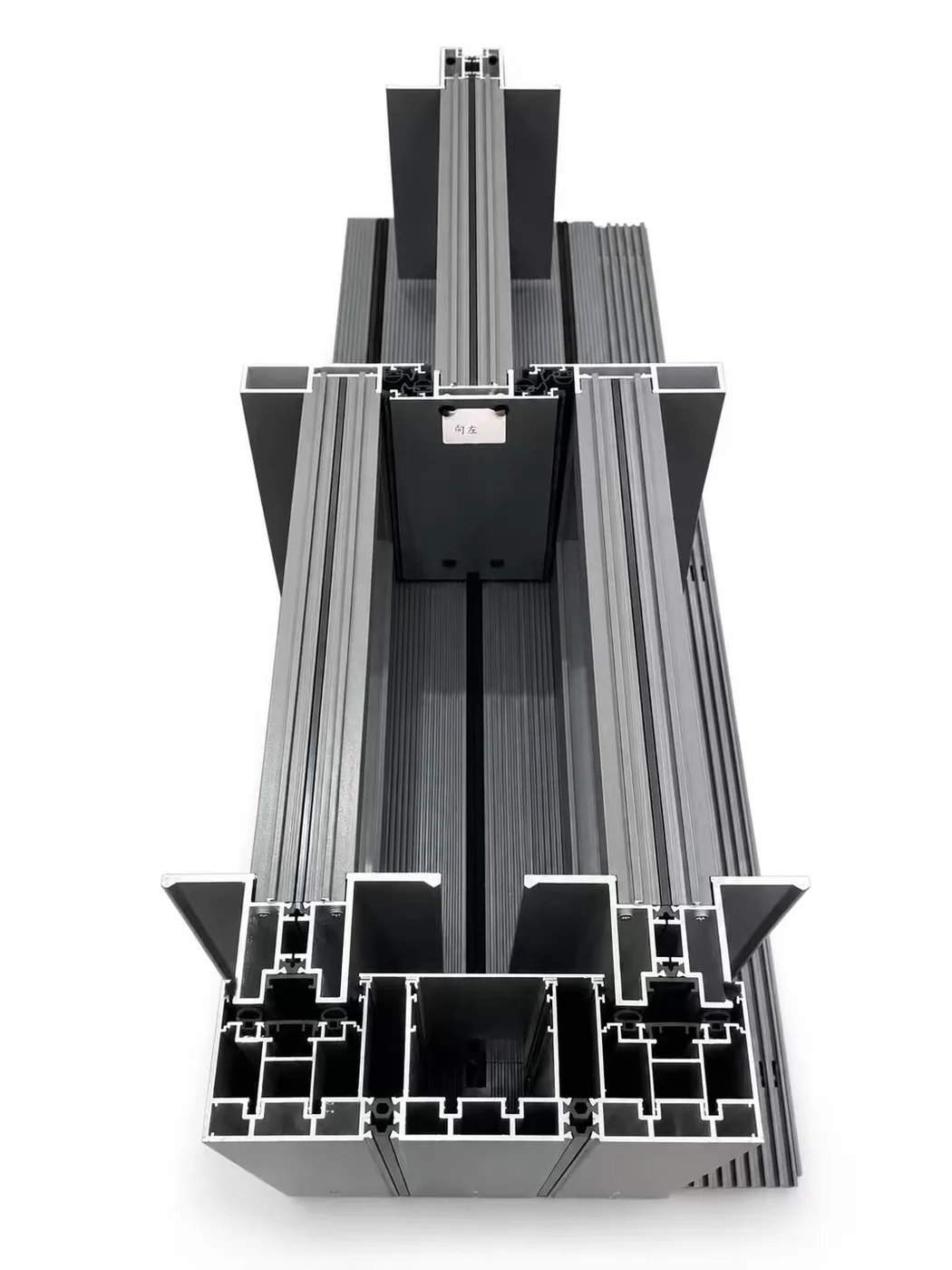
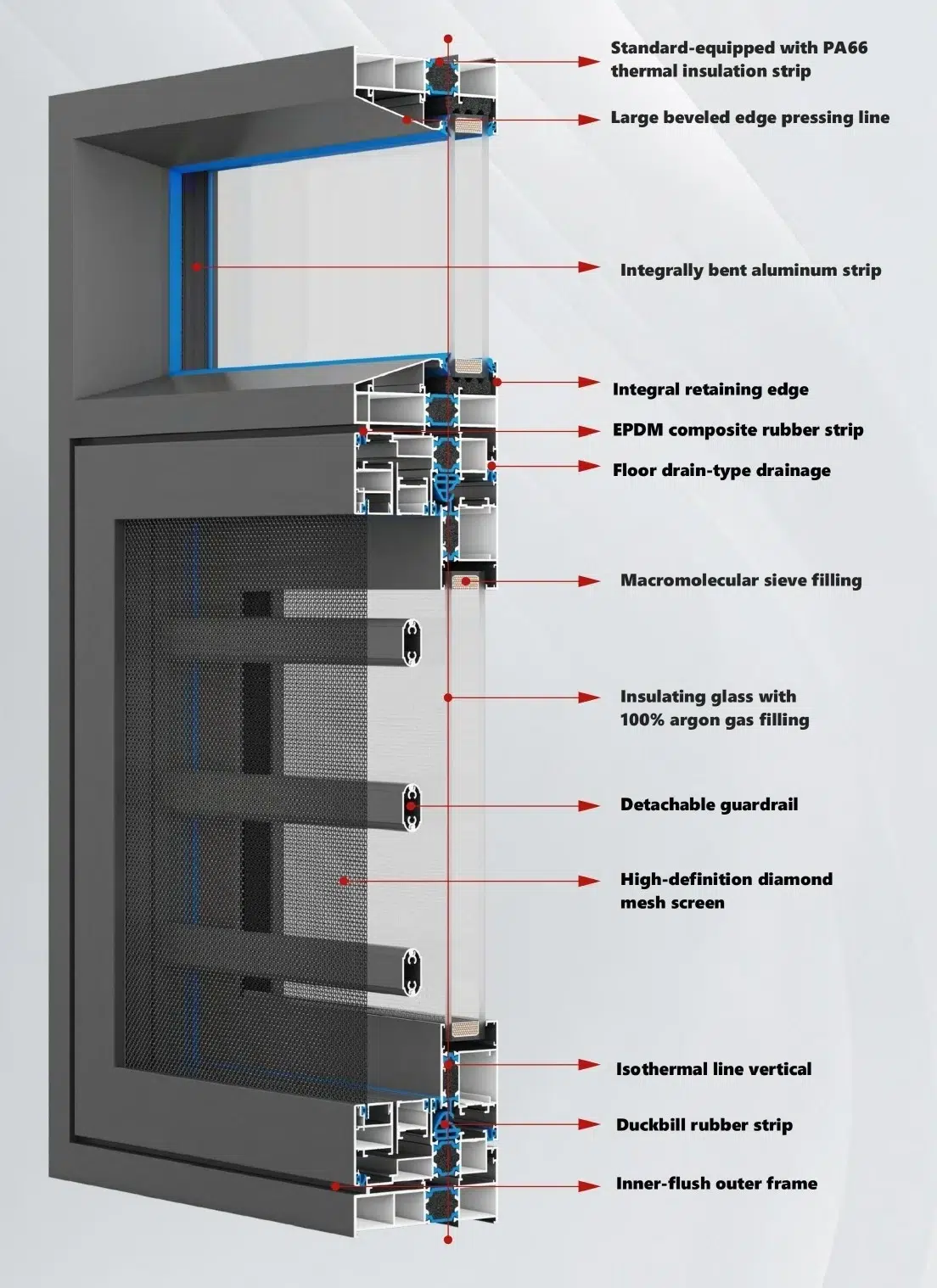
An aluminum casement profile should be evaluated as part of the building envelope, not as an isolated aluminum frame. For villas, luxury residences and architectural projects, the window affects thermal comfort, acoustic control, water resistance, structural stability and the appearance of the facade. The MT Flying Xingchen 115 Premium System Window brings these requirements together in one engineered platform.
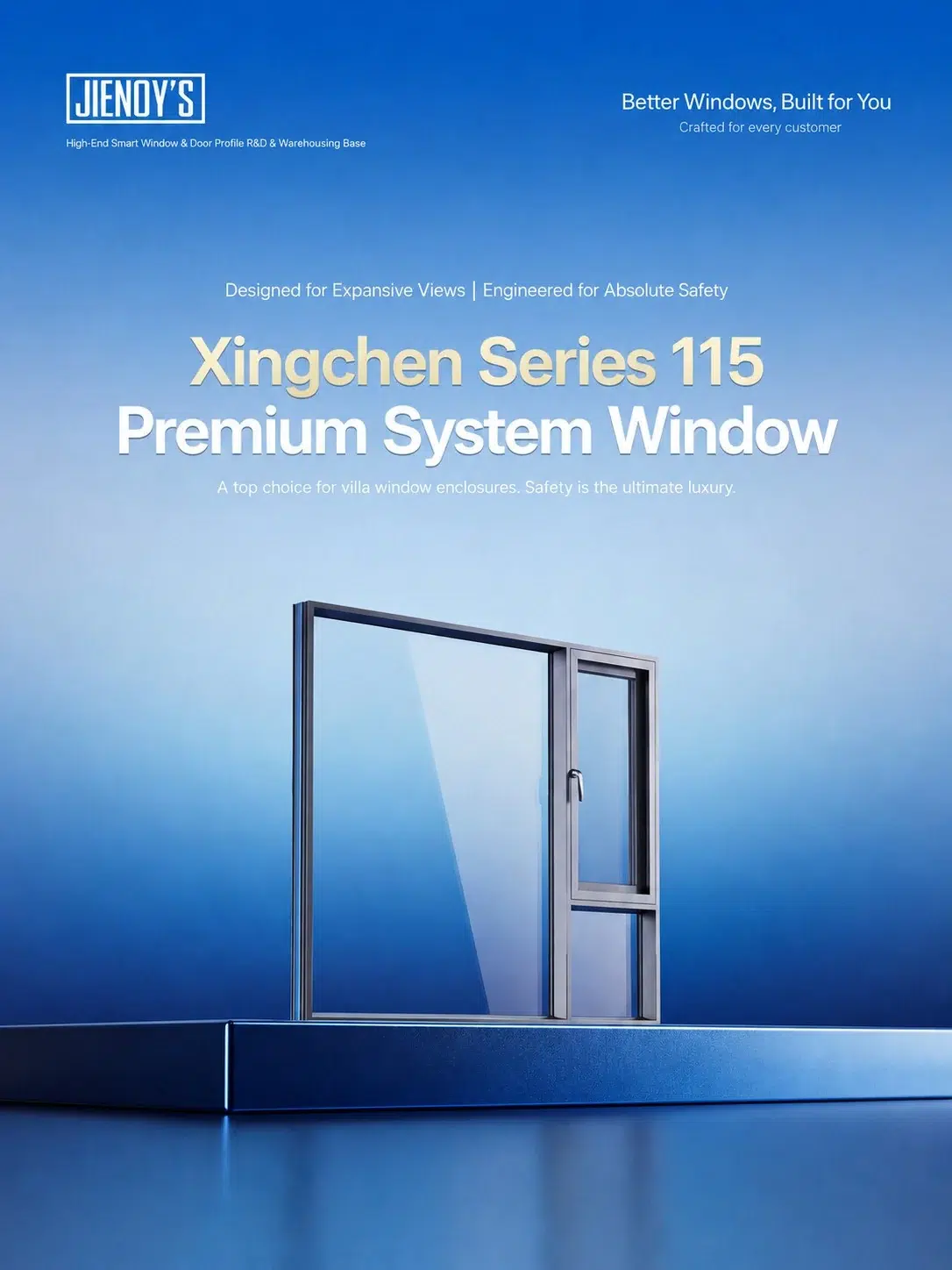
Aluminum casement profile specifications: 115 Series
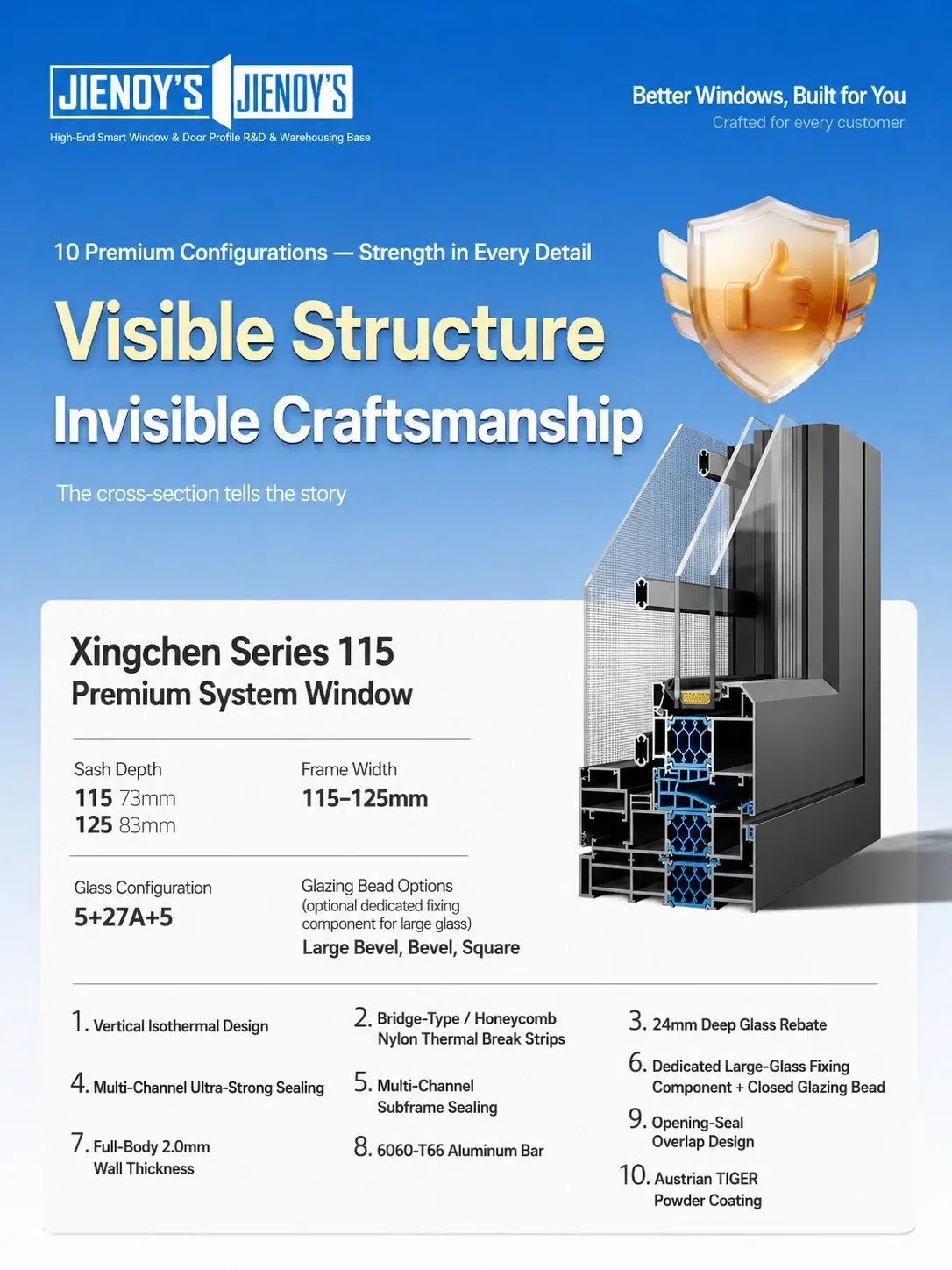
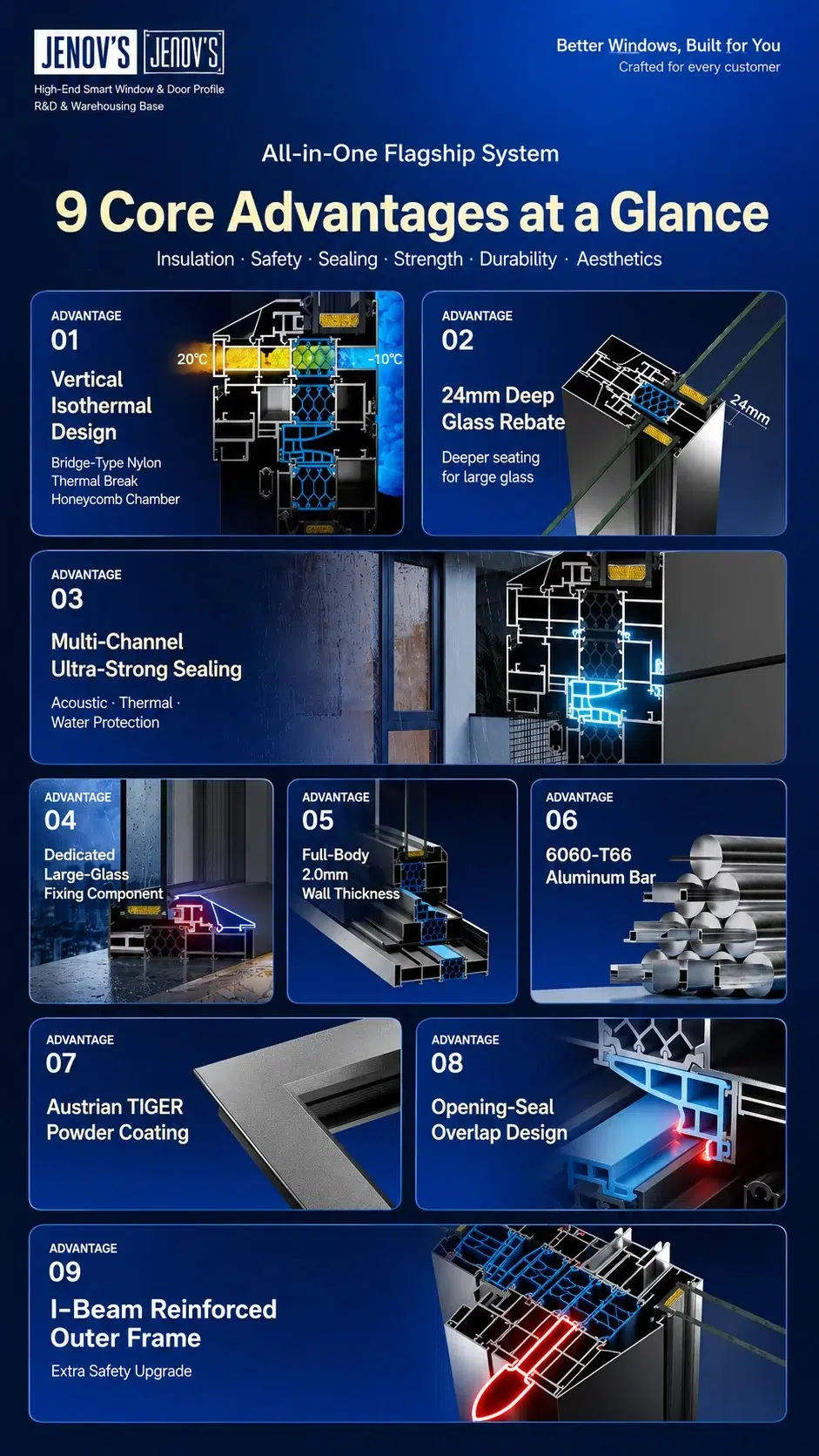
The Xingchen 115 combines a substantial 115-125mm frame platform, full-body 2.0mm aluminum wall thickness, vertical isothermal design, bridge-type and honeycomb nylon thermal breaks, a 24mm deep glass rebate and multi-channel sealing. It is designed for buyers who need more than a lightweight residential extrusion.
| System detail | Project purpose |
|---|---|
| 115-125mm frame platform | Space for reinforcement, insulation, sealing and glass support |
| Full-body 2.0mm wall thickness | Improved rigidity, connection strength and long-term stability |
| 24mm glass rebate | Deeper engagement and support for large-format glazing |
| Multi-channel EPDM sealing | Multiple barriers against air, rain and noise |
| Austrian TIGER powder coating | Refined architectural finish and exterior weather resistance |
Flexible opening options for modern architecture
The system can support several project configurations, including top-hung opening, tilt opening, pop-up lock operation and ultra-slim opening concepts. Concealed or integrated hardware can help preserve a clean exterior appearance. The final opening method and hardware set should always be confirmed against sash size, glass weight, wind pressure and local building requirements.
A 115-125mm frame for greater structural space
Frame depth creates room for the components that determine performance. The 115-125mm platform gives designers space for thermal-break materials, reinforcement, sealing chambers, hardware interfaces and large-glass support. Compared with a shallow residential profile, this deeper casement profile creates a more substantial foundation for villa windows and demanding exterior applications.
Vertical isothermal and honeycomb thermal-break design
Aluminum conducts heat, so the internal thermal break matters. Xingchen 115 uses a vertical isothermal layout with bridge-type and honeycomb nylon structures. These chambers lengthen the heat-transfer path between exterior and interior sections while adding internal support.
Thermal performance still depends on the complete window: frame and sash geometry, insulation strips, glazing, fabrication, perimeter sealing and installation. Buyers should compare tested complete-window data when a project has a defined energy target.
24mm glass rebate and dedicated large-glass support
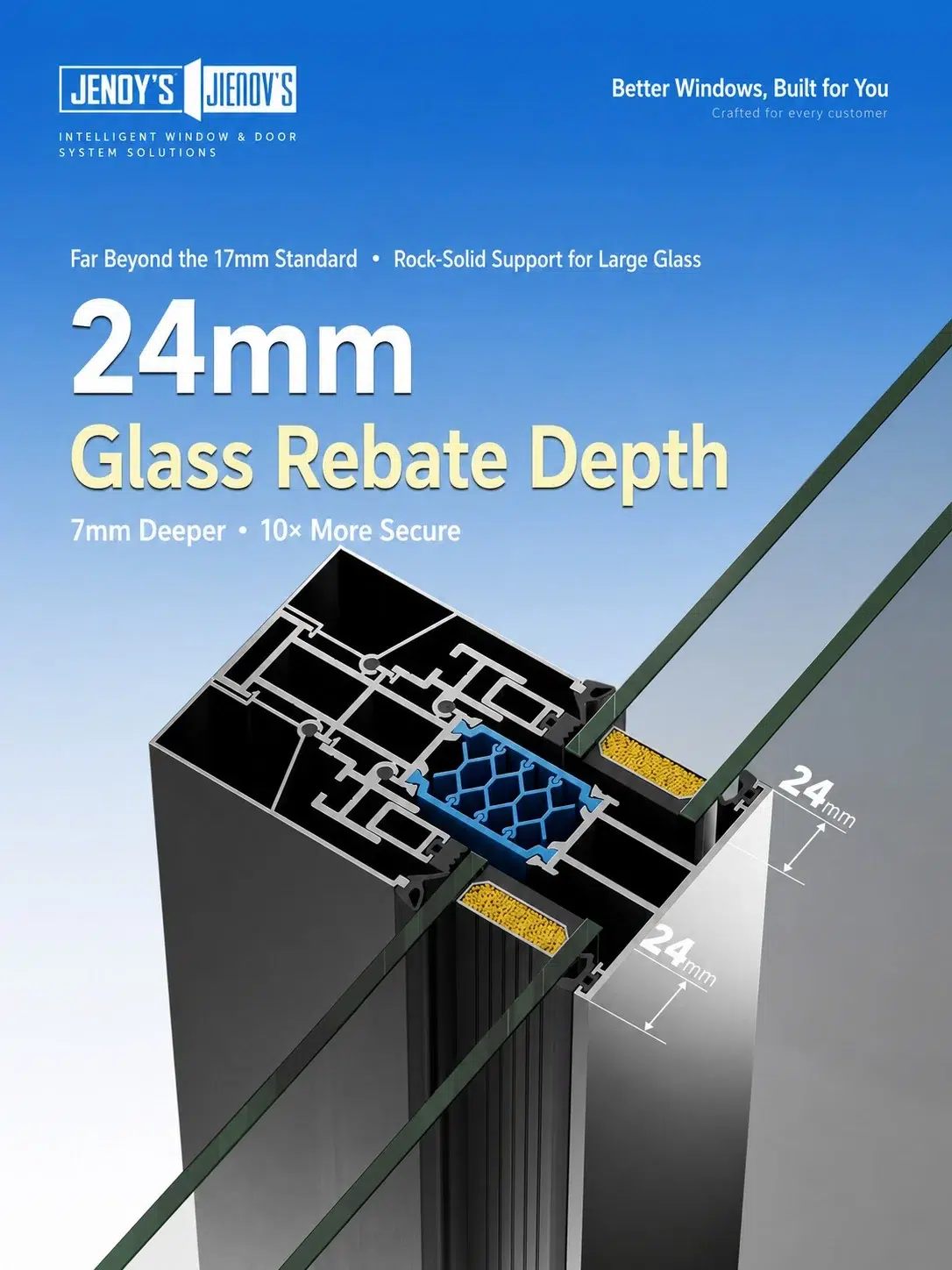
Large glazing creates higher demands at the glass edge. Xingchen 115 uses a 24mm deep rebate, approximately 7mm deeper than the 17mm reference design shown in the product material. Deeper engagement provides more physical support around the glass perimeter.
A dedicated large-glass fixing component works with a closed glazing bead to create two layers of protection against displacement. An I-beam reinforced outer frame further increases resistance to deformation under load. Final glass size and thickness must be engineered for the opening, wind zone, hardware and installation conditions.
Full-body 2.0mm aluminum wall thickness
Wall thickness is easy to reduce when cost becomes the only priority. Xingchen 115 instead uses a full-body 2.0mm wall thickness to create a stronger base for the frame and sash. This can improve profile rigidity, connection strength and long-term dimensional stability.
The shown system specification uses 6060-T66 aluminum. International buyers also frequently search for 6063-T5 architectural extrusion, but alloy and temper alone do not define window performance. Cross-sectional geometry, wall thickness, thermal-break construction, sealing, reinforcement, surface treatment and fabrication accuracy must be evaluated together.
Multi-channel sealing and opening-seal overlap
Air, water and sound commonly pass through joints. Xingchen 115 uses multiple sealing paths plus an opening-seal overlap design so the gaskets and pressure-equalizing structures form several lines of defense. EPDM sealing material is selected for flexibility and weather resistance.
The system is designed for acoustic performance of up to approximately 40 dB, depending on glass specification, finished-window configuration, fabrication quality and installation conditions. Project requirements should be confirmed with test data for the selected configuration.
Austrian TIGER powder coating for exterior exposure
The architectural finish uses Austrian TIGER premium weather-resistant powder coating. The system specification is designed around fade and chalk resistance of up to approximately 20 years under suitable pretreatment, coating application, environment and maintenance conditions. The written warranty agreed for the specific project and finish system remains controlling.
Why work with an aluminum profile source factory?
A source factory can coordinate extrusion engineering, thermal breaks, sealing channels, hardware interfaces, glazing support and surface finishing. For distributors and fabricators, this integration can simplify custom dimensions, sample approval, technical communication, packaging and repeat production. Explore MT Flying’s aluminum profiles, window and door profile systems and custom aluminum extrusion capabilities.
Related Aluminum Window Profile Systems
Compare this aluminum casement profile with other aluminum window profiles and thermal break window profiles. Send section drawings, opening dimensions, glazing, finish and quantities for a fabrication review and project quotation.